
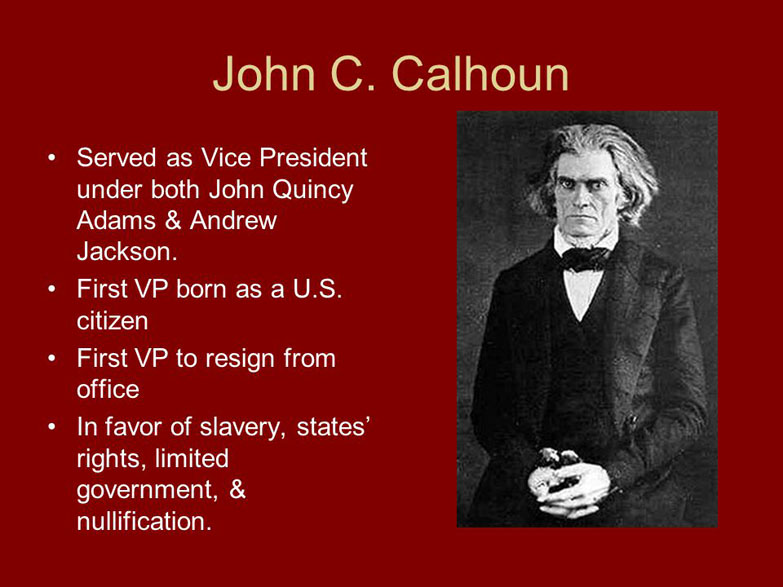
Image Source: bowienewsonline.com
Why Did John C. Calhoun Resign As Vice President?
John C. Calhoun resigned as Vice President of the United States on December 28, 1832. His decision was driven by a complex interplay of personal ambition, evolving political ideologies, and profound disagreements with President Andrew Jackson, most notably concerning the nullification crisis.
John C. Calhoun’s time as Vice President was marked by significant political turmoil. He served under two different presidents: John Quincy Adams and Andrew Jackson. His tenure under Jackson, in particular, proved to be a period of intense political disputes Vice President Calhoun found increasingly untenable. The deep ideological chasm between Calhoun and Jackson, coupled with Calhoun’s own aspirations and his commitment to the interests of his home state, South Carolina, ultimately led to his unprecedented resignation from the nation’s second-highest office.
The Ascent of a Southern Statesman
Born in 1782 in South Carolina, John C. Calhoun’s early life was steeped in the traditions and concerns of the Southern planter class. He received a solid education, graduating from Yale College and later studying law. His early political career was meteoric. He served in the U.S. House of Representatives, where he quickly distinguished himself as a gifted orator and a fervent nationalist. During the War of 1812, Calhoun was a leading advocate for war, earning him the moniker “The War Hawk.” His early years in national politics were characterized by a belief in a strong federal government, a vision that would later dramatically shift as his political philosophy evolved.
His rise to prominence continued with his appointment as Secretary of War under President James Monroe. In this role, Calhoun demonstrated significant administrative skill and further cemented his reputation as a rising star in American politics. His focus was on professionalizing the military and improving its efficiency.
The Vice Presidency: A Strained Partnership
Calhoun’s election as Vice President in 1824, under John Quincy Adams, marked a significant step in his national career. However, this initial partnership was fraught with tension. Calhoun harbored presidential ambitions and felt that Adams was not sufficiently supportive of his aims. This period laid the groundwork for the deeper conflicts that would emerge when he was re-elected Vice President in 1828, this time under Andrew Jackson.
The 1828 election was a particularly contentious one. Jackson, a military hero and a populist figure, won a decisive victory. Calhoun, a prominent figure in the Adams administration, found himself in the unusual position of Vice President to a man with whom he had a strained relationship, especially after the “corrupt bargain” allegations of the 1824 election where Jackson felt his victory was stolen.
The Nullification Crisis: The Breaking Point
The most significant factor leading to John C. Calhoun’s resignation was his central role in the nullification crisis. This crisis, which erupted in the early 1830s, centered on the issue of tariffs. The Tariff of 1828, often referred to as the “Tariff of Abominations,” significantly raised duties on imported goods, which many in the South, particularly South Carolina, viewed as detrimental to their economy. They believed the tariff unfairly benefited the industrial North at the expense of the agricultural South, which relied heavily on international trade.
Calhoun, initially a proponent of protective tariffs, began to champion the doctrine of nullification as a way for states to resist what they perceived as unconstitutional federal laws. He argued that the Constitution was a compact among sovereign states, and that any state had the right to nullify, or void, a federal law within its borders if it deemed that law unconstitutional. This was a radical departure from his earlier nationalist views.
Key Tenets of Nullification:
- State Sovereignty: The ultimate authority resides in the states.
- Compact Theory: The Constitution is an agreement between states.
- Right to Resist: States can reject federal laws they deem unconstitutional.
This doctrine placed Calhoun in direct opposition to President Jackson, a staunch believer in the Union and federal authority. Jackson famously declared, “Our Federal Union: It must be preserved!” in response to toasts at a White House dinner, a clear rebuke to the principles of nullification. Calhoun, in turn, proposed a toast of his own: “The Union: next to our liberty, the most dear. May we all remember that it can only be preserved by respecting the rights of the states and distributing equally the benefit and burden of the government.” The tension was palpable.
The crisis intensified when South Carolina, under Calhoun’s ideological leadership, passed an ordinance of nullification in November 1832, declaring the tariffs of 1828 and 1832 null and void within the state and threatening secession if the federal government attempted to enforce them.
Calhoun’s Conflict with Jackson
The Calhoun’s conflict with Jackson was not solely about policy; it was also deeply personal. Their political paths had diverged significantly. Jackson saw Calhoun’s nullification stance as a direct threat to the nation’s unity and his presidency. Calhoun, feeling increasingly alienated and misunderstood by Jackson, and believing that his position as Vice President was compromised, began to plan his exit.
The Peggy O’Neill Eaton affair also played a role in the deterioration of their relationship. This social scandal involved the wife of Secretary of War John H. Eaton and the wives of other cabinet members who ostracized her. Calhoun’s wife was seen as a leader in this social ostracism. The affair exposed deep divisions within Jackson’s cabinet and further alienated Calhoun from the President. Jackson, who had a strong sense of loyalty and was protective of his friends, was deeply offended by the behavior of Calhoun and his supporters. This personal animosity undoubtedly fueled the political disagreements.
Reasons for Calhoun Leaving VP: A Multifaceted Decision
The decision for Calhoun leaving VP was not made lightly. It stemmed from several interconnected factors:
- Irreconcilable Differences with Jackson: The political disputes Vice President Calhoun had with President Jackson over nullification and states’ rights were fundamental. Calhoun felt he could no longer serve effectively in an administration whose policies and principles he so vehemently opposed.
- Desire to Defend South Carolina’s Interests: Calhoun felt a profound duty to defend the interests of his home state. He believed that his position as Vice President prevented him from speaking out as forcefully and directly as he wished in support of South Carolina’s stance on nullification.
- Presidential Ambitions: Calhoun’s presidential ambitions were a constant driving force in his career. He recognized that his role as Vice President under Jackson, especially with their strained relationship, offered little prospect for him to ascend to the presidency. By resigning, he could position himself as a free agent and a leading voice for Southern interests, hoping this would boost his chances in future presidential elections.
- Seeking a Platform for His Views: Calhoun wanted to be in a position where he could more actively and openly articulate and defend his political philosophy, particularly his theories on states’ rights and nullification. The Senate offered a more suitable platform for this than the executive branch, where his public statements were constrained by his office.
- The “Cabinet Resignation” Precedent: While not a direct resignation from the Vice Presidency, the earlier mass resignation of Jackson’s cabinet in 1831, partly in response to the Peggy O’Neill Eaton affair and growing policy disagreements, created a precedent for drastic political action. Calhoun was aware of the power of such a move.
The Resignation and its Aftermath
On December 28, 1832, John C. Calhoun formally submitted his resignation as Vice President. This was an unprecedented event in American history. No Vice President had ever resigned from office before. The act was bold and carried significant implications for the ongoing political debates.
Calhoun’s resignation immediately cleared the way for him to be elected to the Senate by the South Carolina legislature. In the Senate, he found a much more receptive audience for his arguments regarding states’ rights and the perceived injustices of federal policies. He became a leading voice in the opposition to Jackson’s policies, particularly the Force Bill, which authorized the President to use military force to enforce federal laws in South Carolina. Calhoun argued passionately against the bill, believing it was a tyrannical assertion of federal power.
Calhoun’s Senate Career Highlights:
- Champion of States’ Rights: He became the preeminent defender of states’ rights and the institution of slavery.
- Opposition to Jackson: He was a vocal critic of President Jackson’s policies.
- Advocate for Southern Interests: His speeches and writings consistently focused on protecting the economic and social structures of the South.
- “Positive Good” Argument for Slavery: Calhoun famously argued that slavery was a “positive good,” a stark contrast to earlier Southern justifications that viewed it as a “necessary evil.”
His resignation, while seen by some as a betrayal of national unity, was viewed by many in South Carolina and the wider South as a courageous act of defiance against an overreaching federal government. It solidified his image as a defender of Southern interests and a brilliant, albeit controversial, political thinker.
Historical Context of Calhoun’s Resignation
The historical context Calhoun resignation is crucial for a complete appreciation of his actions. The United States in the 1830s was a nation still grappling with its identity and the balance of power between the federal government and individual states. The legacy of the American Revolution, with its emphasis on individual liberty and suspicion of centralized power, was still potent.
The economic disparities between the industrializing North and the agrarian South, heavily reliant on slave labor, created deep-seated tensions. Debates over tariffs, internal improvements, and the expansion of slavery were constant sources of conflict. Calhoun, a product of this era and a keen observer of its dynamics, sought to find a constitutional framework that protected the interests of the South within the Union.
His theory of nullification was an attempt to reconcile these conflicting interests, offering a states’ rights solution to perceived federal overreach. While ultimately unsuccessful in preventing the Civil War, his arguments and his role in the nullification crisis profoundly shaped the discourse on states’ rights and secession in the antebellum South.
Legacy and Impact
John C. Calhoun’s resignation as Vice President remains a significant event in American political history. It demonstrated the deep divisions within the young republic and foreshadowed the sectional conflicts that would eventually lead to the Civil War. His political philosophy, particularly his unwavering defense of states’ rights and his complex arguments for the perpetuation of slavery, continues to be debated and analyzed by historians.
Calhoun’s political career was one of immense influence, even after leaving the Vice Presidency. His intellectual prowess and his passionate advocacy for his beliefs made him a towering figure in American political thought. While his legacy is complex and controversial, his role in challenging the prevailing national narrative and advocating for a radical interpretation of states’ rights undeniably left an indelible mark on the nation’s history. His resignation was not merely a personal political maneuver; it was a pivotal moment that underscored the irreconcilable differences that were tearing the nation apart.
Frequently Asked Questions (FAQ)
Q1: Why did John C. Calhoun resign as Vice President?
A1: John C. Calhoun resigned as Vice President in 1832 primarily due to irreconcilable political differences with President Andrew Jackson, especially concerning the nullification crisis, his desire to more forcefully defend South Carolina’s interests, his presidential ambitions, and his wish to articulate his political philosophy more freely from a Senate seat.
Q2: What was the nullification crisis?
A2: The nullification crisis was a political confrontation between South Carolina and the federal government in the early 1830s. South Carolina, influenced by Calhoun’s theories, declared federal tariffs unconstitutional and void within the state, arguing for the doctrine of nullification.
Q3: Was John C. Calhoun the first Vice President to resign?
A3: Yes, John C. Calhoun was the first and, to date, the only Vice President of the United States to resign from office.
Q4: What were Calhoun’s presidential ambitions?
A4: Calhoun harbored significant presidential ambitions throughout his career. He believed his position as Vice President under Andrew Jackson offered limited prospects for him to achieve this goal, especially given their political disagreements. His resignation allowed him to pursue the presidency independently.
Q5: How did Calhoun’s resignation affect his political career?
A5: His resignation allowed him to return to the Senate, where he became a leading voice for Southern interests and states’ rights. It freed him to publicly advocate his controversial views and potentially enhanced his standing as a presidential candidate, though he never won the presidency.
Q6: What was the primary disagreement between Calhoun and President Jackson?
A6: The primary disagreement stemmed from Calhoun’s advocacy of the doctrine of nullification, which Jackson vehemently opposed as a threat to the Union. Their conflict was also fueled by personal animosity and differing views on the balance of power between states and the federal government.
Q7: Did the Peggy O’Neill Eaton affair contribute to Calhoun’s resignation?
A7: While not the sole cause, the Peggy O’Neill Eaton affair significantly strained the relationship between Jackson and Calhoun. Calhoun’s perceived leadership in ostracizing Mrs. Eaton deepened the personal animosity and contributed to the overall breakdown of their political partnership, making Calhoun’s position as Vice President increasingly untenable.
Q8: What was Calhoun’s South Carolina politics like after his resignation?
A8: After resigning, Calhoun became a dominant figure in South Carolina politics. He was elected to the Senate and used it as a platform to vigorously defend the state’s interests and his theories of states’ rights and nullification, becoming a powerful advocate for the Southern cause.