
Did many people see Jesus after he came back to life? Yes, the Bible tells us that many individuals and groups saw Jesus after his resurrection.
The question of how many people witnessed the resurrected Jesus is central to understanding the foundation of Christian beliefs. The New Testament, particularly the Gospels and the letters of Paul, provides numerous accounts of Jesus’ post-resurrection sightings. These resurrection appearances are often cited as resurrection proof and are critical to the historical claims of Christianity. Examining these testimonies offers a fascinating glimpse into the early Christian community and the impact of the resurrection on Jesus’ followers.
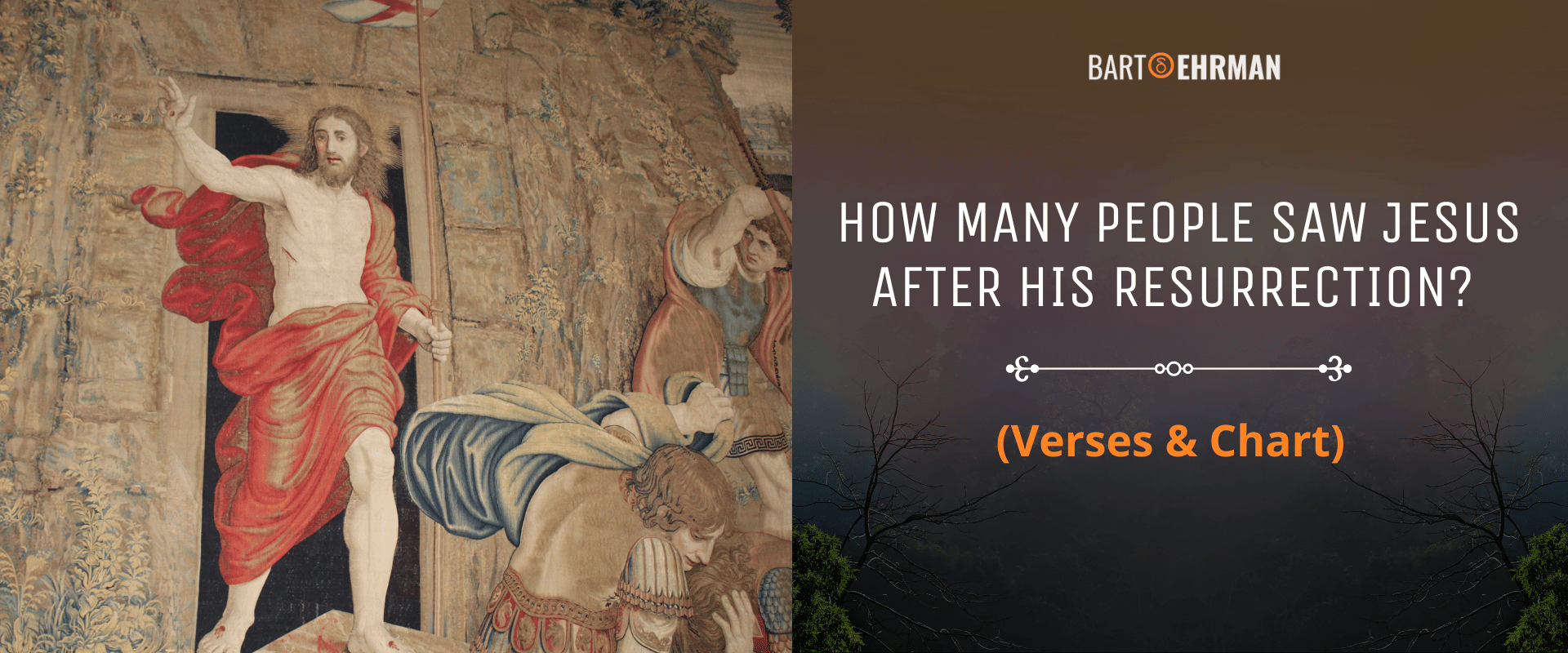
Image Source: www.bartehrman.com
The Core Testimony: Eyewitness Accounts Jesus
The core of the Christian faith rests on the belief that Jesus Christ rose from the dead. This belief is supported by numerous eyewitness accounts Jesus provided after His crucifixion. These accounts are not mere hearsay; they are presented as direct encounters with the resurrected Christ. The Bible meticulously records these encounters, detailing where, when, and with whom Jesus appeared. This detailed record aims to establish the reality of the resurrection, distinguishing it from mere legend or myth. The consistency and breadth of these Resurrection appearances across different Gospels and biblical texts lend significant weight to their veracity within the framework of Christian scripture.
Early Christian Beliefs and the Resurrection
Christian beliefs resurrection are not a peripheral aspect of the faith; they are the very cornerstone. The Apostle Paul, in his letter to the Corinthians, emphasizes this point dramatically: “And if Christ has not been raised, our preaching is useless and so is your faith” (1 Corinthians 15:14). This highlights the vital importance placed on the resurrection from the earliest days of Christianity. The accounts of the Resurrected Jesus witnesses were the primary source of evangelism and the bedrock upon which the early church was built. Without the resurrection, the movement would have likely dissolved. The sheer number of reported sightings, involving various individuals and groups, serves to strengthen this foundational belief.
Listing the Resurrected Jesus Witnesses: A Detailed Look
The Bible presents a compelling narrative of the Resurrected Jesus witnesses. These were not isolated incidents but a series of encounters that solidified the belief in Jesus’ resurrection among His followers. Here’s a breakdown of some of the key individuals and groups who saw Jesus after His resurrection, based on the gospel testimonies:
The First Witnesses: Mary Magdalene and Other Women
The earliest reported sighting of the resurrected Jesus is by Mary Magdalene. The Gospel of John describes her encounter at the tomb: “But Mary stood weeping outside the tomb. As she wept, she bent over to look into the tomb, and she saw two angels in white, sitting where the body of Jesus had been lying, one at the head and the other at the feet. They said to her, ‘Woman, why are you weeping?’ She said to them, ‘They have taken my Lord, and I do not know where they have put him.’ Having said this, she turned back and saw Jesus standing there, but she did not know that it was Jesus. Jesus said to her, ‘Woman, why are you weeping? Whom are you seeking?’ Supposing him to be the gardener, she said to him, ‘Sir, if you have carried him away, tell me where you have laid him, and I will take him away.’ Jesus said to her, ‘Mary.’ She turned and said to him in Aramaic, ‘Rabboni!’ (which means Teacher).” (John 20:11-16).
Following this, Jesus also appeared to other women who had come to the tomb. Matthew’s Gospel records: “And behold, Jesus met them, saying, ‘Greetings!’ And they came up and took hold of his feet and worshiped him. Then Jesus said to them, ‘Do not be afraid; go and tell my brothers to go to Galilee, and there they will see me.'” (Matthew 28:9-10). These women were among the first to carry the news of the resurrection, acting as crucial early Resurrected Jesus witnesses.
The Disciples Saw Jesus: The Road to Emmaus
One of the most poignant Resurrection appearances is described in Luke’s Gospel, where two disciples saw Jesus as they walked to Emmaus. They were discussing the events of Jesus’ crucifixion and the rumors of His resurrection, unaware that Jesus Himself was walking with them.
“Now that same day two of them were going to a village called Emmaus, about seven miles from Jerusalem, and they were talking with each other about all these things that had happened. As they talked and discussed these things with each other, Jesus himself came up and walked with them; but they were kept from recognizing him.” (Luke 24:13-16).
It was only when Jesus broke bread with them that their eyes were opened, and they recognized Him. This encounter highlights how Jesus revealed Himself to His followers, often in unexpected ways, reinforcing the reality of His physical presence.
The Apostles’ Encounter: The Upper Room
Perhaps the most significant gathering of Resurrected Jesus witnesses occurred in the upper room, where the apostles were assembled. The Gospel of John vividly describes this moment: “On the evening of that day, the first day of the week, the doors being locked where the disciples were for fear of the Jews, Jesus came and stood among them and said to them, ‘Peace be with you.'” (John 20:19). This appearance provided immense comfort and validation to the disciples, who were still reeling from the events of the crucifixion.
Later, Jesus appeared to them again when Thomas was present. Thomas, having been absent during the first appearance, famously expressed his doubt: “Unless I see in his hands the mark of the nails, and place my finger into the mark of the nails, and place my hand into his side, I will never believe.” (John 20:25). Jesus then appeared specifically to Thomas, saying, “Put your finger here, and see my hands; and put out your hand, and place it into my side. Do not disbelieve, but believe.” (John 20:27). This interaction is a powerful testament to the tangible nature of Jesus’ resurrected body and serves as compelling resurrection proof.
Jesus Appears to Peter
Luke’s Gospel also mentions that Jesus appeared specifically to Peter: “Then he told them, ‘This is what is written: The Messiah will suffer and rise from the dead on the third day, and repentance that brings forgiveness of sins will be preached in his name to all nations, beginning with Jerusalem. You are witnesses of these things.'” (Luke 24:46-48). This personal appearance to Peter, who had famously denied Jesus three times, is seen as an act of restoration and a commissioning to ministry.
Appearances to the Five Hundred
The Apostle Paul, in his extensive discourse on the resurrection in 1 Corinthians 15, mentions an appearance to a large group: “Then he appeared to more than five hundred of the brothers at the same time, most of whom are still living, though some have fallen asleep.” (1 Corinthians 15:6). This account is crucial because it points to a multitude saw Jesus. This large number of witnesses suggests that the resurrection was not a private event but a public demonstration that impacted a significant portion of the early Christian community. The fact that many of these witnesses were still alive when Paul wrote this letter implies they could be consulted, lending further credibility to his testimony.
Jesus Appears to James
Paul also notes an appearance to James, Jesus’ brother: “Then he appeared to James, then to all the apostles.” (1 Corinthians 15:7). James, initially a skeptic, became a prominent leader in the early Jerusalem church after Jesus’ resurrection. This personal encounter would have profoundly impacted his faith and his subsequent ministry.
Jesus Appears to the Apostles as They Fish
The Gospel of John provides another detailed account of the disciples saw Jesus after His resurrection. This time, it was by the Sea of Galilee. Peter, Thomas, Nathanael, James, and John, along with two other unnamed disciples, were fishing without success. Jesus appeared on the shore, though the disciples did not recognize Him at first. He instructed them to cast their net on the right side of the boat, resulting in a miraculous catch of 153 fish. This event, reminiscent of His earthly ministry, led John to exclaim, “It is the Lord!” (John 21:7). This encounter demonstrates Jesus’ continued care and provision for His followers.
The Great Commission and the Ascension
The final recorded appearance in the Gospels is the Great Commission, where Jesus meets His disciples on a mountain in Galilee. Matthew records: “Now the eleven disciples went to Galilee, to the mountain to which Jesus had directed them. And when they saw him they worshiped him, though some doubted. And Jesus came and said to them, ‘All authority in heaven and on earth has been given to me. Go therefore and make disciples of all nations, baptizing them in the name of the Father and of the Son and of the Holy Spirit, teaching them to obey everything that I have commanded you. And behold, I am with you always, to the end of the age.'” (Matthew 28:16-20).
The book of Acts then describes the ascension of Jesus into heaven: “And when he had said these things, as they were looking on, he was lifted up, and a cloud took him out of their sight. And while they were gazing into heaven as he went, behold, two men stood by them in white robes and said, ‘Men of Galilee, why do you stand looking into heaven? This Jesus, who was taken up from you into heaven, will come in the same way as you saw him go into heaven.'” (Acts 1:9-11). This event marked the end of His earthly post-resurrection appearances but provided a promise of His eventual return.
Analyzing the Resurrection Accounts
The resurrection accounts across the various biblical texts, while differing in some details, present a remarkably consistent overall picture. This consistency, rather than being a sign of contradiction, is often seen as evidence of independent reporting. Each Gospel writer had a unique perspective and audience, leading to slightly different emphases and narrative structures.
Consistency Across the Gospels
- Empty Tomb: All four Gospels agree that Jesus’ tomb was found empty.
- Angelic Messengers: The presence of angels or heavenly beings at the tomb is reported in Matthew, Luke, and John.
- Appearances to Women: All Gospels mention women as the first witnesses to the resurrection.
- Appearances to Disciples: The Gospels and Acts confirm that Jesus appeared to His disciples on multiple occasions.
- The Great Commission: Matthew, Mark, and Luke record Jesus commissioning His followers to spread the Gospel.
Differences in Detail
The differences, such as the number of women at the tomb, the order of appearances, or the specific individuals present at each sighting, are typical of independent eyewitness testimony. Human memory and reporting are not always perfectly synchronized. For instance, John’s Gospel focuses on the empty tomb and appearances to Mary Magdalene, Peter, and the beloved disciple, while Matthew emphasizes the angelic visitors and the appearance to the women. Luke details the Emmaus road encounter and the appearance in Jerusalem, while Mark provides a concise summary.
These variations do not invalidate the core message but rather offer a richer, more robust tapestry of events, as if multiple witnesses are each recounting their experience of the same overarching reality. This diversity strengthens the case for genuine historical accounts rather than a single, fabricated narrative.
How Many People Saw The Resurrected Jesus: A Statistical Approach?
It is impossible to provide an exact number of how many people saw the resurrected Jesus. The Bible does not offer a census of all resurrection witnesses. However, by piecing together the accounts, we can infer that the number was significant, certainly in the hundreds, and potentially more.
Let’s consider the groups mentioned:
- Mary Magdalene: 1
- Other Women (unspecified number but at least two): Likely a small group.
- Two Disciples on the Road to Emmaus: 2
- The Eleven Apostles (initially): 11
- The Apostles plus Thomas (later): 11 (or possibly more if others were present)
- Peter: 1 (mentioned specifically by Paul and implied in Luke)
- More than 500 Brothers at one time: 500+
- James: 1
- All the Apostles (again, likely including the 11 plus others): Unspecified, but certainly a significant number.
- Disciples by the Sea of Galilee (Peter, Thomas, Nathanael, James, John, and two others): 7
- The Eleven Disciples at the Great Commission: 11 (or possibly more if some had rejoined)
Table: Summary of Resurrected Jesus Witnesses Mentioned in Scripture
| Witness Group | Approximate Number | Primary Biblical References |
|---|---|---|
| Mary Magdalene | 1 | John 20:11-18 |
| Other Women at the Tomb | Small group | Matthew 28:9-10 |
| Disciples on the Road to Emmaus | 2 | Luke 24:13-35 |
| Apostles in the Upper Room | 11 | John 20:19-29, Luke 24:36-43, Mark 16:14 |
| Peter | 1 | 1 Corinthians 15:5, Luke 24:34 |
| More than 500 Brothers | 500+ | 1 Corinthians 15:6 |
| James (Jesus’ brother) | 1 | 1 Corinthians 15:7 |
| Apostles (again) | Unspecified | 1 Corinthians 15:7 |
| Disciples by the Sea of Galilee | 7 | John 21:1-23 |
| Disciples at the Great Commission | 11+ | Matthew 28:16-20, Mark 16:15-18 |
Summing these up, even conservatively, we are looking at well over 500 individuals who are explicitly stated to have seen the resurrected Christ. The mention of “more than five hundred” is a significant data point, suggesting that the appearances were widespread and impacted a substantial portion of the early Christian community. The cumulative evidence points to a significant number of Resurrected Jesus witnesses.
The Significance of the Appearances: Resurrection Proof
The numerous Resurrection appearances are central to the concept of resurrection proof. The early church did not rely on abstract theological arguments alone; they pointed to the tangible, verifiable experiences of those who saw and interacted with the resurrected Jesus.
Transformation of the Disciples
The most compelling evidence of the resurrection’s impact is the dramatic transformation of Jesus’ followers. Before His death, the disciples were often described as fearful, confused, and scattered. After the resurrection, they were bold, courageous, and unashamedly preached the Gospel, even in the face of persecution and death. This transformation is difficult to explain if the resurrection was a fabrication.
The disciples’ willingness to suffer and die for their belief in the resurrected Christ is a powerful testimony to their conviction. Many traditions hold that most of the apostles met violent deaths, yet they did not recant their faith. This unwavering commitment is often seen as strong resurrection proof.
The Early Church Growth
The rapid growth of the early Christian church is another indicator of the impact of the resurrection. The message of a crucified and resurrected Messiah was radical and counter-cultural. Yet, it resonated deeply with people, leading to widespread conversions and the establishment of communities throughout the Roman Empire. This evangelistic success was fueled by the eyewitness testimonies of the Resurrected Jesus witnesses.
Addressing Skepticism and Alternative Explanations
Over the centuries, various explanations have been proposed to account for the resurrection accounts without accepting the supernatural event itself. Some common skeptical theories include:
- The Disciples Stole the Body: This theory, famously addressed by Jesus’ opponents in Matthew 28:11-15, suggests the disciples fabricated the resurrection by stealing the body. However, this doesn’t explain the disciples’ transformed behavior or their willingness to die for their belief. It also doesn’t account for the appearance to over 500 people.
- The “Swoon” Theory: This theory posits that Jesus did not actually die on the cross but merely fainted and was later revived. This is medically implausible, given the brutality of Roman crucifixion and the spear thrust into Jesus’ side. Furthermore, a weakened, barely conscious Jesus would not have inspired the bold proclamation of the disciples.
- Hallucination Theory: This suggests that the appearances were mass hallucinations or visions experienced by the disciples due to grief, wishful thinking, or psychological stress. However, the detailed, interactive nature of the appearances, including eating with Jesus and touching His wounds, makes widespread, consistent hallucinations unlikely. The appearance to over 500 people simultaneously is particularly problematic for this theory.
- Myth or Legend: This view proposes that the resurrection accounts developed over time as legends grew around Jesus. However, the early date of Paul’s writings (which predate some Gospel accounts and mention the appearances to over 500) and the rapid emergence of the resurrection as a central tenet of Christianity argue against a slow, mythological development.
The gospel testimonies and the writings of Paul offer a compelling case for the historical reality of the resurrection, supported by a significant number of Resurrected Jesus witnesses.
The Enduring Impact of the Resurrected Jesus Sightings
The appearances of the resurrected Jesus were not just isolated events; they were transformative moments that fundamentally shaped the course of history. They provided the impetus for the Christian mission and continue to be the bedrock of Christian beliefs resurrection today.
The numerous Resurrection appearances offer rich eyewitness accounts Jesus provided to His devoted followers. These accounts, preserved in the New Testament, serve as the primary resurrection proof for the Christian faith. The testimonies of Mary Magdalene, the disciples on the road to Emmaus, the apostles in the upper room, and the large group of over five hundred believers all contribute to a robust narrative of Jesus’ victory over death. Fathoming the impact of these appearances means recognizing the profound change they wrought in the lives of those who encountered the risen Christ, empowering them to share the message of salvation with the world.
The sheer volume and consistency of these accounts, detailing Jesus’ post-resurrection sightings, underscore their importance in the early Christian movement. The belief that a multitude saw Jesus alive after His crucifixion provided the essential validation for the disciples’ message and the foundation for the burgeoning Christian faith.
Frequently Asked Questions (FAQ)
Q1: Who was the first person to see the resurrected Jesus?
According to the Gospel of John, Mary Magdalene was the first person to see the resurrected Jesus at the tomb.
Q2: Did only the disciples see Jesus after the resurrection?
No, the Bible mentions appearances to women, the disciples, and importantly, an appearance to “more than five hundred brothers at the same time,” indicating a large group witnessed the resurrected Jesus.
Q3: How reliable are the Bible’s resurrection accounts?
The Bible’s resurrection accounts are considered reliable by believers because they are presented as eyewitness testimonies, are consistent in their core message across multiple sources (Gospels, Paul’s letters), and explain the radical transformation of Jesus’ followers and the rapid growth of the early church.
Q4: What is the significance of Jesus appearing to over 500 people?
The appearance to over 500 people at once is significant because it suggests a public, verifiable event, providing strong resurrection proof. It signifies that the resurrection was not a private experience but a widely witnessed reality that impacted a substantial portion of the early Christian community.
Q5: Can the resurrection be proven historically?
Many historians and scholars argue that the historical evidence for the resurrection, including the empty tomb, the transformation of the disciples, and the existence of the early church, provides a strong case for its historicity. However, as with any historical event, absolute empirical proof is debated, and belief often involves faith. The eyewitness accounts Jesus provided are central to this historical argument.
Q6: What are some key differences in the resurrection accounts?
Some differences include the number of women at the tomb, the order of appearances, and the specific individuals present at each sighting. These variations are often seen as strengths, suggesting independent reporting rather than a fabricated, synchronized story. They contribute to a fuller picture of the Resurrection appearances.