
How many people saw Jesus after He was resurrected? The Bible lists at least 500 individuals who witnessed Jesus after His resurrection, though many more are implied. These sightings, known as post-resurrection appearances, are a cornerstone of Christian belief.
The period following Jesus’s resurrection is rich with accounts of His interactions with followers. These appearances weren’t just fleeting glimpses; they were substantive encounters that solidified faith, provided instruction, and commissioned the early church. Determining the exact number of people who saw Jesus after He was resurrected requires careful examination of the biblical narratives. The Gospels and the Book of Acts provide us with a detailed, though not exhaustive, list of these significant encounters.
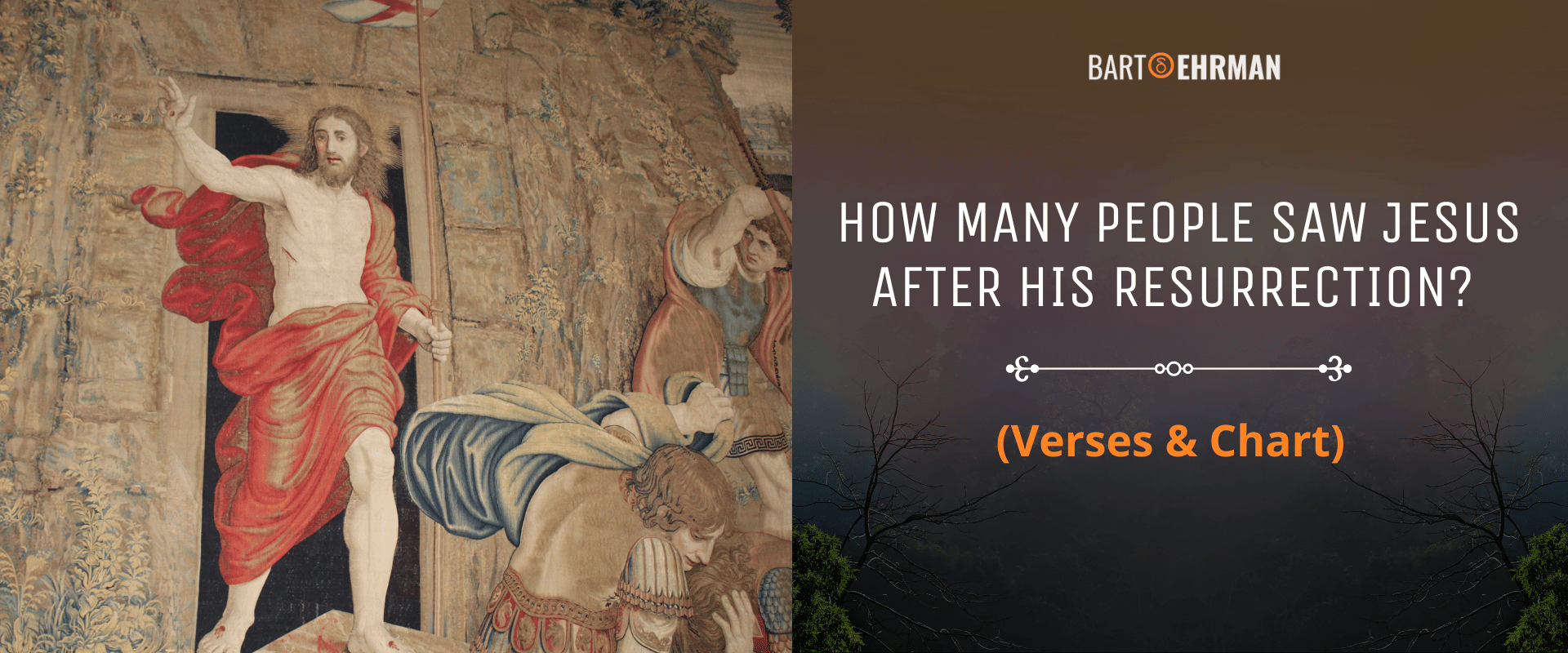
Image Source: www.bartehrman.com
The Significance of Post-Resurrection Appearances
The appearances of Jesus after His resurrection serve several crucial purposes within the Christian narrative:
- Validation of the Resurrection: The sheer number and diversity of witnesses lend credibility to the resurrection itself. It wasn’t just a select few; many people from different backgrounds and in various settings saw Jesus alive.
- Reassurance and Instruction: Jesus used these encounters to comfort His grieving followers, dispel their doubts, and further instruct them on the nature of His kingdom and their mission.
- Empowerment for Ministry: He commissioned the disciples, promising them the Holy Spirit and authority to spread the Gospel.
- Confirmation of His Identity: These appearances affirmed that Jesus was indeed the same person who had been crucified, now glorified and victorious over death.
The Initial Witnesses: The Women at the Tomb
The very first to discover the empty tomb and, according to some accounts, to see angels announcing Jesus’s resurrection were the women who had followed Him. These brave women, who had stayed with Jesus through His crucifixion, were the initial heralds of the good news.
Mary Magdalene’s Encounter
Among the most prominent of the women at the tomb was Mary Magdalene saw Jesus. Her encounter is recounted in multiple Gospels (John 20:11-18, Mark 16:9). She was weeping outside the tomb when Jesus appeared to her, initially mistaken for the gardener. Jesus called her by name, and her immediate recognition and joy highlight the personal nature of these early appearances. Her role as the “apostle to the apostles” underscores the importance of her witness.
Other Women at the Tomb
While Mary Magdalene is the most detailed, other women were also present at the tomb. Matthew’s Gospel mentions “Mary Magdalene and the other Mary” (Matthew 28:1) going to see the tomb. Luke’s account also refers to other women who accompanied Mary Magdalene (Luke 24:10). While it’s not explicitly stated they all saw Jesus directly at that moment, their presence at the scene of the resurrection is significant.
Appearances to the Disciples: Building Faith and Dispelling Doubt
The disciples saw Jesus in numerous gatherings, both individually and in groups. These were crucial moments for rebuilding their faith, which had been shattered by Jesus’s crucifixion.
The Locked Room Appearance
One of the most significant post-resurrection appearances occurred on the evening of the resurrection day. The disciples saw Jesus, including many of the apostles, gathered in a locked room, likely in Jerusalem, out of fear of the Jewish authorities.
- Jesus’s Entry: Jesus suddenly appeared among them, despite the doors being shut. This demonstrated His transformed, resurrected body, capable of transcending physical barriers.
- Peace and Commission: He greeted them with “Peace be with you” (John 20:19-23), a profound statement in light of their earlier fear and despair. He then showed them His hands and side, proving His identity. He breathed on them and said, “Receive the Holy Spirit,” commissioning them to forgive sins.
Thomas’s Doubt and Faith
A pivotal moment in the disciples’ journey of faith involved Thomas’s doubt. He was absent during the first appearance in the locked room. When the other disciples told him, “We have seen the Lord,” he famously declared, “Unless I see in his hands the mark of the nails, and place my finger into the mark of the nails, and place my hand into his side, I will never believe” (John 20:24-29).
Eight days later, Jesus appeared again to the disciples, with Thomas present. Jesus directly addressed Thomas’s skepticism, inviting him to touch His wounds. Thomas’s response, “My Lord and my God!” marked a powerful moment of confession and solidified his faith. This event highlights Jesus’s knowledge of individual needs and His patient approach to His followers.
Appearances to Peter
Appearances to Peter are also notably mentioned. While not detailed in every Gospel, Peter’s restoration after his denial of Jesus is a significant theme. John 21:1-19 recounts a post-resurrection appearance to Peter and several other disciples by the Sea of Galilee. Jesus provided for them and then engaged Peter in a series of questions about his love for Jesus, directly countering Peter’s earlier threefold denial. This intimate encounter served to reaffirm Peter’s calling and prepare him for leadership.
The Emmaus Road Journey
Another remarkable post-resurrection appearance is detailed in Luke 24:13-35, involving two disciples on the road to Emmaus.
- Unrecognized Presence: As they walked and discussed the recent events, Jesus Himself joined them, though they did not recognize Him.
- Scriptural Interpretation: Jesus patiently explained how the Scriptures foretold the Messiah’s suffering and glory.
- Revelation in the Breaking of Bread: Their eyes were opened to His identity when He broke bread with them at their invitation. This act mirrored the Last Supper and became a symbolic moment of recognition. Upon realizing who He was, Jesus vanished from their sight, and they hurried back to Jerusalem to tell the others.
The Great Commission and Ascension Witnesses
Jesus’s ministry continued beyond the initial days, culminating in His Great Commission and ascension.
The Galilean Mountain Appearance
Matthew’s Gospel describes Jesus appearing to His disciples on a mountain in Galilee (Matthew 28:16-20). This is a crucial setting for the Great Commission.
- Worship and Doubt: Some disciples worshipped Him, while others still doubted. Jesus addressed their wavering faith with reassurance.
- Authority Declared: He declared, “All authority in heaven and on earth has been given to me.”
- The Great Commission: He then famously commanded them, “Go therefore and make disciples of all nations, baptizing them in the name of the Father and of the Son and of the Holy Spirit, teaching them to obey everything that I have commanded you.”
The Ascension Witnesses
The ascension witnesses were the group of disciples who accompanied Jesus to the Mount of Olives. This event, recorded in Luke 24:50-53 and Acts 1:1-11, marked the end of His physical presence on earth.
- A Final Blessing: Jesus lifted His hands and blessed them.
- Promise of the Holy Spirit: While blessing them, He was lifted up into heaven, and a cloud hid Him from their sight.
- Angelic Announcement: Two men in white, likely angels, appeared to them and reassured them that Jesus would return in the same way He had departed.
Other Significant Appearances
Beyond these primary accounts, other appearances are mentioned, either directly or indirectly, adding to the impressive list of resurrection witnesses.
Appearance to James
The Apostle Paul, in his letter to the Corinthians (1 Corinthians 15:7), mentions a specific appearance to James, Jesus’s brother. This encounter is not detailed in the Gospels but is significant as James later became a prominent leader in the Jerusalem church. This appearance likely played a role in James’s transformation from a skeptic to a fervent follower.
Appearance to the Five Hundred
Paul also mentions a large-scale appearance to “more than five hundred brothers at one time” (1 Corinthians 15:6). This is perhaps the most extensive post-resurrection appearance list, suggesting that Jesus was seen by a considerable crowd of believers. The implication is that many of these witnesses were still alive when Paul was writing, providing a strong historical testimony to the resurrection.
Appearance to Paul (Saul)
While not a witness to the initial resurrection appearances, Paul’s dramatic conversion on the road to Damascus (Acts 9:1-19) is described as an encounter with the resurrected Christ. He himself considered this a post-resurrection appearance and a primary source of his apostolic authority.
Synthesizing the Witness List: How Many Saw Jesus?
When compiling the accounts, we can identify distinct groups and individuals:
| Group/Individual | Gospel/Book Reference | Approximate Number of Witnesses | Nature of Appearance |
|---|---|---|---|
| Women at the Tomb | Matthew, Mark, Luke, John | At least 4-5 | Angels’ announcement, Jesus’s appearance (Mary Magdalene) |
| Simon Peter | Luke, John | 1 | By the Sea of Galilee |
| Two Disciples | Luke | 2 | Emmaus road |
| The Ten Apostles | Luke, John | 10 (initially) | In a locked room |
| The Eleven Apostles | Matthew, Mark, John | 11 | Galilean mountain, Locked room |
| Thomas | John | 1 | With the eleven |
| James | 1 Corinthians | 1 | Specific appearance to Jesus’s brother |
| Over 500 Brothers | 1 Corinthians | 500+ | Large group appearance |
| All the Apostles | Acts, 1 Corinthians | 11 (likely more as witnesses) | Including Ascension witnesses |
| Paul (Saul of Tarsus) | Acts, 1 Corinthians | 1 | Road to Damascus (conversion experience) |
| Stephen | Acts | 1 | Vision of Christ |
| John | Revelation | 1 | Vision on Patmos |
Important Note: This table focuses on direct physical appearances or recognized visions of the resurrected Christ. The number of individuals who saw Jesus after He was resurrected and were directly impacted by these events is significant, easily reaching into the hundreds, and potentially thousands if we consider all those who heard about the resurrection and believed. The 500+ mentioned by Paul represents a substantial gathering of eyewitnesses.
Challenges in Precise Counting
Pinpointing an exact number is challenging for several reasons:
- Interlapping Groups: Some appearances involved the same individuals at different times.
- Unspecified Numbers: Some accounts mention “the disciples” without specifying how many were present.
- Paul’s Testimony: The “more than five hundred” is a crucial, though unquantified, number.
- Varying Gospel Focus: Each Gospel writer emphasizes different appearances and witnesses.
However, even with these complexities, the consistent testimony across multiple independent sources points to a substantial number of eyewitnesses.
The Enduring Legacy of the Resurrection Witnesses
The post-resurrection appearances are not merely historical anecdotes; they are the bedrock of Christian faith. The testimonies of those who saw Jesus alive after His death provided the conviction and courage for the early church to spread the Gospel throughout the Roman Empire, often at great personal risk. The resurrection witnesses faced persecution, imprisonment, and martyrdom, yet their unwavering belief in the resurrected Christ sustained them.
The Jesus’s post-resurrection ministry was transformative. It shifted the disciples from fear and despair to boldness and purpose. The promise of the Holy Spirit, given during these appearances, empowered them to carry on Jesus’s work. The ascension witnesses were left with a clear commission and the assurance of Christ’s ongoing presence through the Holy Spirit.
From the devoted Mary Magdalene saw Jesus at the tomb to the doubting Thomas’s doubt being overcome, to the entire group of disciples witnessing the Great Commission and the Ascension, each encounter reinforces the reality of the resurrection. The Emmaus road disciples’ journey illustrates how Jesus meets people in their moments of confusion and grief, revealing Himself through Scripture and shared experience. The appearances to Peter highlight Jesus’s mercy and restoration.
Frequently Asked Questions (FAQ)
Q1: Who was the first person to see the resurrected Jesus?
According to the Gospels, Mary Magdalene was among the first, if not the very first, to see the resurrected Jesus.
Q2: Did all the disciples see Jesus after His resurrection?
Not all the original twelve disciples saw Him at every appearance. However, many, if not all, of the apostles and a significant number of other followers saw Him at various times. Paul mentions an appearance to over 500 people at once.
Q3: Why are there different accounts of the resurrection appearances in the Gospels?
The Gospels were written by different authors with different purposes and audiences. They highlight different aspects and witnesses of the resurrection to emphasize its significance from various perspectives.
Q4: Is there any historical evidence outside the Bible for the resurrection appearances?
While non-biblical ancient sources do not detail the specific appearances, they do confirm the rapid spread of belief in Jesus’s resurrection and the existence of His followers shortly after His death. Early non-Christian writers like Tacitus and Josephus mention Jesus and His followers.
Q5: What does “Jesus’s post-resurrection ministry” refer to?
This term encompasses the period after Jesus’s resurrection during which He appeared to His followers, taught them, commissioned them for their mission, and prepared them for His ascension and the coming of the Holy Spirit.