
A seed drill, also known as a seeding machine or planter, is a vital piece of agricultural machinery designed for efficiently and accurately planting seeds. It functions by precisely placing seeds into the soil at a predetermined depth and spacing, ensuring optimal conditions for germination and growth. This planting equipment is a cornerstone of modern crop planting and plays a crucial role in maximizing yields and minimizing waste during the seed distribution process.
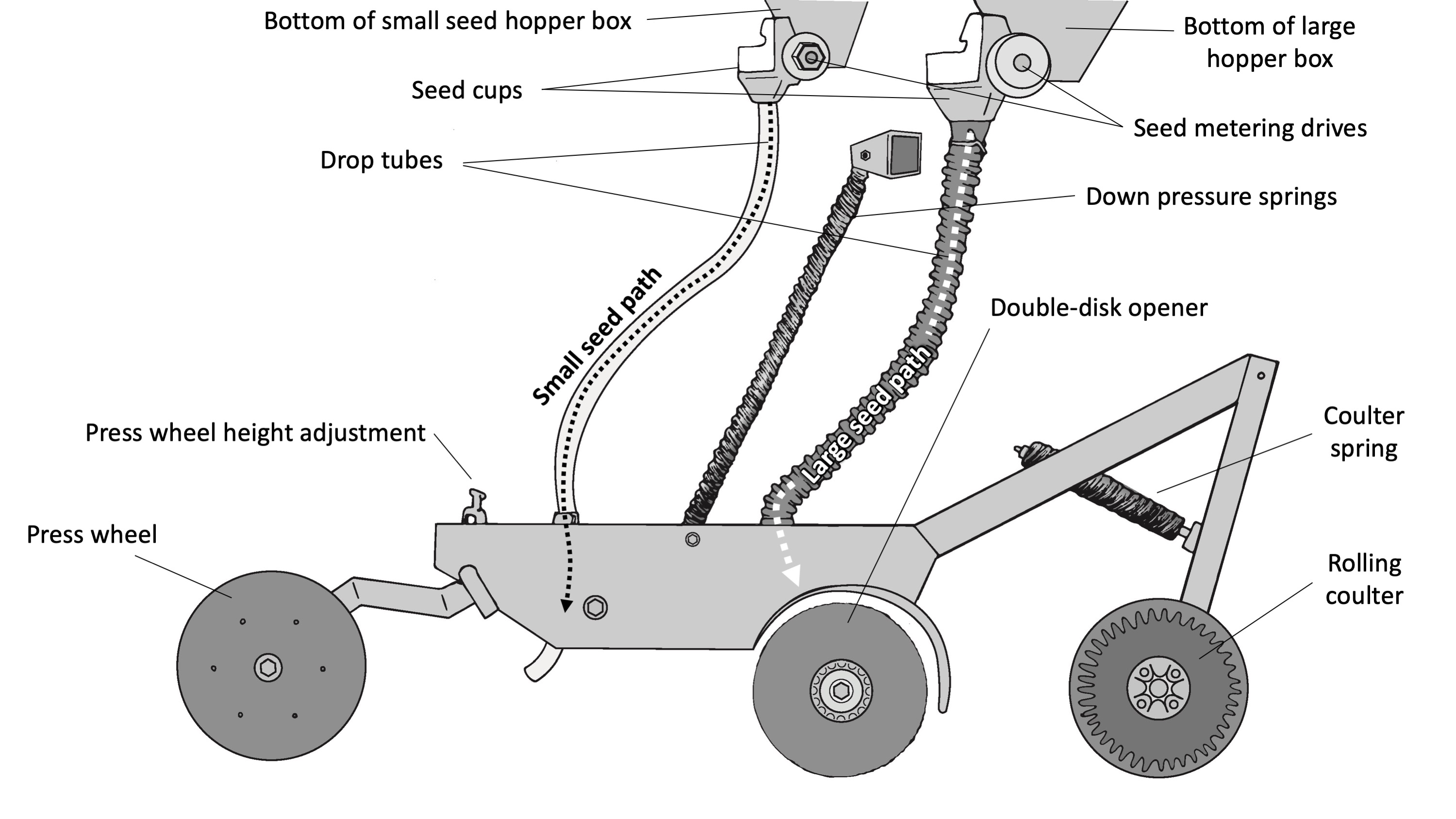
Image Source: secure.caes.uga.edu
Deciphering the Seed Drill’s Core Functionality
At its heart, a seed drill is a sophisticated system that takes seeds from a seed hopper, meters them out at precise intervals, and then deposits them into the soil, often creating a furrow opener as it moves. This controlled approach to sowing is what distinguishes it from older methods like broadcasting, where seeds are scattered randomly. The accuracy of a seed drill directly impacts the uniformity of the crop, its ability to compete with weeds, and ultimately, its yield.
The Mechanics of Seed Placement
The process begins with the seed hopper, a container that holds the bulk of the seeds to be planted. From here, the seeds are fed into the seed metering mechanism. This is arguably the most critical component of the seed drill, as it dictates the rate and accuracy of seed delivery.
Seed Metering: The Brains of the Operation
Seed metering can be achieved through various mechanisms, each with its own strengths and applications. The primary goal of seed metering is to ensure that each seed is placed at the correct distance apart and at the right depth.
-
Fluted Roller Metering: This is a common mechanical metering system. A roller with small flutes or grooves rotates, picking up seeds and dropping them into a delivery tube. The speed of the roller, and thus the seeding rate, can be adjusted by changing the gear ratio or the roller’s rotation speed. This system is generally robust and suitable for a wide range of seed sizes.
-
Brush Wheel Metering: Similar to fluted rollers, brush wheels use a rotating brush to sweep seeds into a chute. Different brush densities and rotation speeds allow for varied seeding rates. This method is often preferred for smaller seeds as the brushes can gently handle them without damage.
-
Disc Metering: This system utilizes rotating discs with precisely sized holes. As the disc rotates, seeds are picked up by these holes and then released into the delivery tube. The size of the holes and the rotation speed determine the seeding rate. Disc meters are known for their high precision, especially for seeds like corn or soybeans.
-
Air Seeders (Pneumatic Metering): These advanced systems use a fan to create airflow that carries seeds from the hopper through delivery tubes to the soil. A metering unit, often a rotating star wheel or an auger, controls the amount of seed entering the airflow. Air seeders offer excellent precision and can handle a wide variety of seed sizes and types, often in large capacities. They are particularly good at maintaining uniform distribution over large areas.
Delivering Seeds to the Soil
Once metered, the seeds travel through flexible or rigid tubes to the furrow opener. The type of opener used depends on soil conditions and the desired planting depth.
The Role of the Furrow Opener
The furrow opener is the part of the planting equipment that physically creates the trench in the soil where the seed will be deposited. Its design is crucial for ensuring that seeds are placed at the correct depth and are covered adequately.
-
Coulters: These are sharp, disc-like blades that cut through the soil, breaking up residue and creating a narrow opening. They are effective in no-till or minimum-till farming systems where crop residue needs to be managed.
-
Shoe Openers: These V-shaped openers press into the soil, creating a furrow. They are often equipped with a small press wheel that lightly firms the soil over the seed. Shoe openers are typically used in well-prepared seedbeds.
-
Double Disc Openers: These consist of two angled discs that rotate against each other, cutting through the soil and forming a furrow. They are very effective at penetrating compacted soil and crop residue, making them popular in various tillage systems.
-
Ripples: These are specialized openers that create a wavy or rippled furrow. This can help with water infiltration and reduce soil erosion.
Depth Control and Seed Coverage
Effective seed drills incorporate mechanisms for precise depth control. This ensures that all seeds are planted at a consistent depth, which is critical for uniform germination. Depth is usually controlled by:
-
Adjustable Gauge Wheels: These wheels are mounted on the furrow opener assembly and run alongside it in the soil. By adjusting their height, the planting depth can be finely tuned.
-
Spring-Loaded Assemblies: The openers are often mounted on spring-loaded arms. This allows them to flex over obstacles and maintain consistent pressure on the soil, aiding in depth control.
After the seed is placed in the furrow, it needs to be covered. This is typically done by:
-
Press Wheels: These wheels follow the furrow opener and gently press the soil over the seed, ensuring good seed-to-soil contact, which is vital for moisture uptake and germination. They can be pneumatic or solid rubber.
-
Harrow Attachments: Some seed drills may have small drag harrows or chains that follow the openers to lightly cover and level the soil.
Types of Seed Drills
Seed drills come in various configurations to suit different farming needs and conditions. Understanding these types can help farmers choose the most appropriate agricultural machinery for their operations.
Integral Seed Drills
These are the simplest and most common types. They are typically mounted directly onto the tractor’s three-point hitch. They are lightweight and maneuverable, making them ideal for smaller farms or operations with varied field shapes.
- Pros: Cost-effective, easy to operate and maintain, good maneuverability.
- Cons: Limited seed hopper capacity, often less sophisticated depth control, can put more stress on the tractor’s hydraulics.
Trailed Seed Drills
These are towed behind the tractor and are generally larger and more robust than integral drills. They often have higher seed capacities and wider working widths.
- Pros: Higher seed capacity, wider working widths for faster fieldwork, less stress on the tractor’s three-point hitch.
- Cons: Less maneuverable, require a more powerful tractor for towing.
Combination Seed Drills
These drills combine the functions of seed drilling and soil cultivation. They often feature a power harrow or disc harrow at the front to prepare a seedbed, followed by the seed metering and placement units.
- Pros: Can perform multiple operations in a single pass, saving time and fuel; excellent for preparing a fine seedbed.
- Cons: Higher initial cost, more complex to operate and maintain, can be heavier.
No-Till Seed Drills
Specifically designed for direct seeding into unploughed land. They feature robust furrow openers capable of cutting through crop residue and compacted soil.
- Pros: Conserves soil moisture, reduces erosion, saves on fuel and labor by eliminating tillage passes.
- Cons: Requires more precise setup and maintenance to handle residue, openers can wear faster.
Pneumatic Seed Drills (Air Seeders)
As mentioned earlier, these use air to convey seeds. They are excellent for large-scale operations and can handle a wide variety of seed types and rates. They are often used for planting small grains, oilseeds, and cover crops.
- Pros: High precision seed distribution, can handle very large hoppers, flexible in terms of seed types and rates, can be equipped with multiple hoppers for fertilizers and small seeds.
- Cons: Higher initial cost, require a power source for the fan (often PTO-driven), can be more complex to set up.
Advantages of Using a Seed Drill for Crop Planting
The adoption of seed drills has revolutionized crop planting practices due to the numerous benefits they offer over traditional methods.
Precision and Uniformity
The primary advantage is the precise placement of seeds. This means:
- Optimal Spacing: Seeds are planted at the correct distance from each other, allowing each plant to access adequate sunlight, water, and nutrients without excessive competition.
- Consistent Depth: Uniform planting depth ensures that seeds germinate at the same time, leading to a more uniform crop stand. This simplifies subsequent operations like harvesting.
Improved Germination and Yield
Good seed-to-soil contact, facilitated by the furrow opener and press wheel, promotes faster and more reliable germination. With optimal spacing and depth, plants are healthier and more robust, leading to:
- Higher Yields: Better resource utilization by each plant translates directly into increased overall crop output.
- Reduced Seed Waste: By planting only the necessary number of seeds at the right depth, less seed is wasted, leading to cost savings.
Efficiency and Time Savings
Seed drills combine multiple operations into one pass. Instead of separate steps for preparing the seedbed, sowing, and covering, a seed drill can accomplish much of this simultaneously. This:
- Saves Fuel and Labor: Fewer passes over the field mean less fuel consumption and reduced labor costs.
- Faster Planting: Wider working widths on many seed drills allow for larger areas to be planted in less time.
Soil Health and Conservation
No-till and minimum-till seed drills contribute significantly to soil health:
- Reduced Erosion: Leaving crop residue on the surface protects the soil from wind and water erosion.
- Improved Soil Structure: Minimizing soil disturbance helps maintain soil structure, beneficial for water infiltration and aeration.
- Moisture Retention: Reduced tillage leads to better retention of soil moisture, which is crucial, especially in arid or drought-prone regions.
Fertilizer Application Integration
Many modern seed drills are equipped with a secondary hopper that can carry fertilizer. This allows for simultaneous placement of seeds and starter fertilizer, providing essential nutrients to young seedlings at the critical early stages of growth. This practice is known as banding and can significantly boost early vigor and yield.
Key Components of a Seed Drill in Detail
To truly appreciate how a seed drill works, a closer look at its individual components is beneficial.
Seed Hopper
- Function: Holds the seeds to be planted.
- Material: Typically made of metal or reinforced plastic.
- Design: Varies in size and shape depending on the drill’s capacity and type. Some have agitators to prevent seed bridging.
- Capacity: Measured in kilograms or liters, ranging from small integral hoppers to very large bulk hoppers on air seeders.
Seed Metering Mechanism
- Function: Controls the rate at which seeds are delivered from the hopper.
- Types: Fluted roller, brush wheel, disc, pneumatic.
- Adjustment: Seeding rate is adjusted by changing the metering mechanism’s speed, roller diameter, or hole size. Calibration is essential for accurate seed distribution.
Drive System
- Function: Powers the seed metering mechanism.
- Sources: Can be ground-driven (using a press wheel or land wheel), PTO-driven (for air seeders), or electrically driven.
- Transmission: Gears, chains, or belts are used to transmit power to the metering units.
Delivery Tubes
- Function: Carry seeds from the metering unit to the furrow opener.
- Material: Can be flexible rubber or plastic for easier routing, or rigid for specific placement.
- Design: Smooth interiors minimize seed damage and sticking.
Furrow Opener
- Function: Creates a trench in the soil for seed placement.
- Types: Coulter, shoe, double disc, rippled disc.
- Depth Control: Integral to the opener assembly, often with adjustable gauge wheels or spring tension.
Press Wheel
- Function: Covers the seed with soil and firms the ground.
- Types: Solid rubber, pneumatic (air-filled), steel.
- Pressure: Adjustable to suit soil conditions.
Frame and Hitch
- Function: Provides structural integrity and connects the drill to the tractor.
- Types: Three-point hitch for integral drills, drawbar for trailed drills.
- Construction: Robust steel construction to withstand field conditions.
Operation and Calibration: Ensuring Precision Planting
The effectiveness of a seed drill relies not just on its design but also on proper operation and meticulous calibration.
Pre-Operation Checks
Before heading to the field, several checks are crucial:
- Inspect for Damage: Check all components for wear, damage, or blockages.
- Lubrication: Ensure all moving parts are properly lubricated.
- Tire Pressure: Inflate tires to the recommended pressure.
- Hopper Contents: Ensure the seed hopper is filled with the correct seed type and quantity.
Calibration Process
Calibration is the process of adjusting the seed drill to deliver the exact amount of seed per unit area. This is essential for achieving the desired seeding rate.
- Determine Target Seeding Rate: This is usually expressed in seeds per acre or kilograms per hectare, based on crop recommendations.
- Calculate Ground Speed: The tractor’s speed affects how much area the drill covers per minute.
- Adjust Metering Mechanism:
- Ground-Driven Drills: Raise the drill off the ground and turn the drive wheel a specific number of revolutions. Collect the seeds dispensed and weigh them. Adjust the metering mechanism (e.g., change gears, adjust roller speed) until the dispensed weight matches the calculated amount for that number of revolutions.
- Pneumatic Drills: This often involves calibrating the fan speed and the metering rotor’s speed. Many modern pneumatic drills have on-board computers that guide the calibration process, often by running the metering unit for a set time and measuring the seed output.
- Field Test: After initial calibration, perform a test run in the field. Measure the area covered and the actual amount of seed used. Make further fine-tuning adjustments as needed.
Field Operation Considerations
- Maintain Consistent Speed: Variations in tractor speed will affect the seeding rate. Use cruise control if available.
- Monitor Seed Flow: Many drills have sensors that alert the operator to blockages or low seed levels in individual delivery tubes.
- Adjust for Conditions: Soil type, moisture, and residue levels can influence how the furrow opener performs. Adjustments to depth control or opener pressure might be necessary.
Innovations in Seed Drill Technology
The evolution of the seed drill continues with technological advancements aimed at further enhancing precision and efficiency.
GPS and Precision Agriculture Integration
Modern seed drills can be equipped with GPS technology for:
- Variable Rate Seeding: Based on soil maps or yield data, seeding rates can be automatically adjusted across different zones of a field.
- Section Control: Automatically shuts off sections of the drill when passing over previously seeded areas (e.g., headlands), preventing overlap and seed waste.
- Auto-Steering: Ensures straight and accurate passes, reducing skips and overlaps.
Advanced Metering Systems
Newer metering systems offer even greater accuracy and flexibility:
- Electric Metering: Allows for precise electronic control of seeding rates, making on-the-go adjustments easier and more accurate.
- Multi-Hopper Systems: Enables the simultaneous planting of different seed types or the application of multiple fertilizers with the seed.
Improved Furrow Openers
Innovations focus on better soil penetration, residue management, and reduced soil disturbance:
- Narrower Openers: Reduce the width of the tilled zone, conserving more soil moisture.
- Self-Sharpening Blades: Reduce maintenance requirements.
- Enhanced Residue Handling: Designs that effectively cut through and move residue out of the furrow.
Frequently Asked Questions (FAQ)
Q1: What is the primary purpose of a seed drill?
A1: The primary purpose of a seed drill is to sow seeds into the ground precisely and efficiently, ensuring consistent depth and spacing for optimal germination and plant growth.
Q2: Can I use any seed with a standard seed drill?
A2: While many seed drills are versatile, it’s best to check the manufacturer’s specifications. Some drills are better suited for specific seed sizes and types. Larger seeds like corn or soybeans might require specialized metering units compared to smaller seeds like wheat or canola.
Q3: How important is calibrating a seed drill?
A3: Calibration is extremely important. It ensures that the correct amount of seed is planted per acre, leading to optimal crop density, better yields, and reduced seed costs. Inaccurate calibration can lead to under-seeding (low yield) or over-seeding (wasted seed, stunted plants).
Q4: What is the difference between a seed drill and a planter?
A4: While often used interchangeably, “planter” typically refers to machinery designed for planting individual large seeds (like corn, soybeans, or cotton) with even greater precision in terms of spacing and depth, often including features for individual row shut-off and fertilizing. “Seed drill” is a broader term, often used for machines planting smaller seeds in rows, like grains or legumes.
Q5: How does a seed drill help conserve soil moisture?
A5: Seed drills, especially those used in no-till or minimum-till systems, minimize soil disturbance. This leaves crop residue on the surface, which acts as a mulch, reducing evaporation and conserving soil moisture. The furrow opener also places seeds below the surface, where moisture is more consistent.
Q6: What kind of tractor do I need to pull a seed drill?
A6: The required tractor horsepower depends on the size and type of seed drill, as well as the soil conditions. Smaller integral drills may only need a modest tractor (e.g., 30-60 HP), while larger trailed or combination drills, especially those requiring significant tillage, might need tractors of 100 HP or more. Always consult the seed drill manufacturer’s recommendations.
Conclusion
The seed drill is an indispensable tool in modern agriculture, transforming the age-old practice of sowing seeds into a science of precision. By meticulously controlling seed placement, depth, and spacing, this sophisticated piece of agricultural machinery empowers farmers to maximize their yields, conserve resources, and promote sustainable farming practices. From the careful selection of seeds in the seed hopper to the accurate seed distribution guided by the sowing mechanism, every component plays a vital role. As technology continues to advance, seed drills are becoming even smarter, integrating GPS and variable rate capabilities to offer unparalleled control and efficiency in crop planting, ensuring a more productive and sustainable future for agriculture.