
The question of how many people saw Jesus after his resurrection is answered by examining the biblical testimonies. Several groups and individuals are recorded as having seen Jesus post-crucifixion, with estimates suggesting a significant number of post-resurrection witnesses.
The narrative of Jesus’ resurrection is central to Christianity. While the crucifixion is a historical event debated by some scholars, the claims of Jesus appearing to his followers after his death are foundational to the faith. These resurrection appearances are not just isolated incidents but form a pattern of evidence presented in ancient texts, primarily the New Testament Gospels and the writings of the Apostle Paul. The reliability and scope of these eyewitness accounts are crucial for validating the resurrection claims.
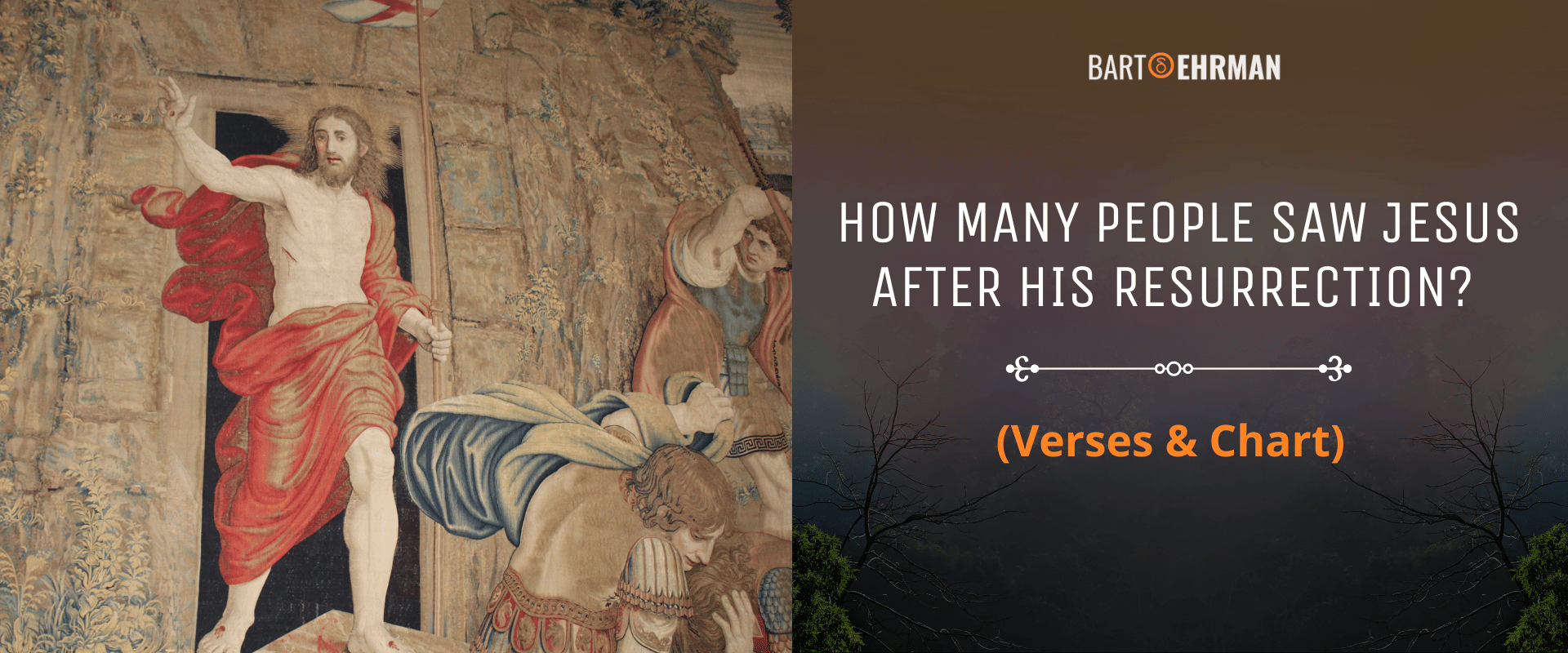
Image Source: www.bartehrman.com
Deciphering the Biblical Testimonies
The primary source for information regarding individuals who saw Jesus after death comes from the New Testament. The Gospels of Matthew, Mark, Luke, and John, along with the Book of Acts and Paul’s epistles, provide detailed accounts of Jesus’ interactions with his disciples and others following his resurrection. These biblical testimonies offer a consistent, albeit varied, picture of Jesus’ post-resurrection ministry.
The First Witnesses: The Women at the Tomb
The earliest accounts of Jesus’ resurrection focus on women discovering the empty tomb. While they did not see the resurrected Jesus at that moment, their experience of the angelic announcement is the precursor to the subsequent appearances.
- Mary Magdalene: Often cited as the first to see the resurrected Jesus (John 20:14-18). Her initial encounter was personal, and she was commissioned to tell the disciples.
- Other Women: Matthew’s Gospel mentions Mary Magdalene and “the other Mary” seeing the resurrected Jesus as they went to give the disciples the news (Matthew 28:9-10).
These initial encounters, while emotionally charged and deeply personal, set the stage for larger gatherings.
The Disciples’ Encounters: A Growing Circle of Witnesses
The days following the resurrection saw Jesus appearing to his closest followers. These disciples’ encounters were pivotal in transforming their grief and despair into bold proclamation.
The Road to Emmaus
Luke’s Gospel recounts Jesus appearing to two disciples on the road to Emmaus. They did not recognize him at first, but their hearts burned within them as he spoke and explained the scriptures. Only when he broke bread with them did their eyes open, and they realized who he was (Luke 24:13-35). This encounter highlights the gradual nature of recognition and the profound impact of Jesus’ presence.
The Upper Room Appearances
One of the most significant sets of post-resurrection appearances occurred when Jesus appeared to his disciples gathered in an upper room, with the notable exception of Thomas being absent on the first occasion.
- Appearance to the Eleven (minus Thomas): John 20:19-23 records Jesus appearing to the assembled disciples. He showed them his hands and side, bringing them peace and commissioning them to continue his work. This event would have involved the eleven apostles present.
- Appearance to the Eleven (including Thomas): A week later, Jesus appeared again, this time with Thomas present. Thomas, famously, had expressed disbelief until he could see and touch Jesus’ wounds. Jesus addressed his doubt directly, providing him with the tangible proof he sought (John 20:24-29). This appearance includes the original eleven plus Thomas.
These gatherings in the upper room represent a significant number of believers witnessing the resurrected Christ.
Other Notable Appearances
Beyond these key moments, several other appearances are recorded, widening the circle of post-resurrection witnesses.
- To Peter: While not detailed in terms of a specific encounter in all Gospels, Luke’s account of the Emmaus road journey mentions that the two disciples found the eleven and those with them saying, “The Lord has risen indeed, and has appeared to Simon!” (Luke 24:34). This suggests a significant appearance to Peter alone.
- To the Disciples by the Sea of Galilee: John chapter 21 describes Jesus appearing to a group of his disciples, including Peter, Thomas, Nathanael, James, and John, who were fishing. Jesus prepared a meal for them, and this encounter marked a significant moment of restoration for Peter. This gathering involved at least seven disciples.
- The Great Commission Appearance: Matthew’s Gospel records Jesus meeting with his disciples in Galilee on a mountain. Here, Jesus gives the “Great Commission,” sending them out to make disciples of all nations (Matthew 28:16-20). This is a crucial event involving the wider group of disciples, likely numbering more than just the core twelve.
The Large Crowd Appearance
Perhaps the most substantial recorded appearance in terms of numbers is mentioned by the Apostle Paul.
- To Over 500 Brothers at Once: In his first letter to the Corinthian church, Paul writes, “Then he appeared to more than five hundred of the brothers at one time, most of whom are still alive, though some have fallen asleep” (1 Corinthians 15:6). This is a powerful piece of resurrection evidence, as Paul references a large, verifiable group, many of whom were still living when he wrote his letter. This accounts for a significant number of individuals who saw Jesus after death.
The Ascension Witnesses
The final recorded public appearance of Jesus before his ascension also serves as resurrection evidence.
- The Ascension: The Book of Acts describes Jesus being taken up into heaven in the presence of his disciples, specifically mentioning “about forty days after his passion” (Acts 1:3-11). While the exact number of disciples present for the ascension isn’t specified, it’s implied to be a gathering of his followers, likely a significant portion of those who had witnessed his earlier appearances. The account mentions the apostles being present, and they would have relayed this experience to others.
Tabulating the Eyewitness Accounts
To better visualize the scope of post-resurrection witnesses, we can compile the information from biblical accounts:
| Group/Individual | Gospel/Epistle Reference | Approximate Number of Witnesses | Notes |
|---|---|---|---|
| Mary Magdalene | John 20:14-18 | 1 | First reported witness. |
| The Other Women | Matthew 28:9-10 | A few | Saw Jesus as they went to tell disciples. |
| Two Disciples on Emmaus Road | Luke 24:13-35 | 2 | Recognized him at the breaking of bread. |
| The Eleven (minus Thomas) | John 20:19-23 | 11 | Jesus showed them his wounds. |
| The Eleven (with Thomas) | John 20:24-29 | 11 | Thomas touched Jesus’ wounds. |
| Peter | Luke 24:34; 1 Corinthians 15:5 | 1 | Mentioned by Luke, confirmed by Paul. |
| Disciples by the Sea | John 21:1-23 | At least 7 | Peter, Thomas, Nathanael, James, John, and two others. |
| The Great Commission Group | Matthew 28:16-20 | Many | Disciples gathered in Galilee on a mountain. |
| Over 500 Brothers | 1 Corinthians 15:6 | 500+ | Largest single group mentioned; most were still alive at the time of writing. |
| Ascension Witnesses | Acts 1:3-11 | Many (likely disciples) | Present at Jesus’ bodily ascension into heaven. |
It’s important to note that these are reported appearances and the exact number of individuals present at each event is not always precisely stated. However, the cumulative number of people who are said to have seen Jesus after his resurrection is substantial.
Beyond the Gospels: Paul’s Testimony and the Early Church
The Apostle Paul, who was not one of the original twelve disciples, provides critical resurrection evidence. His conversion experience involved a dramatic appearance of the risen Christ, which he recounts multiple times.
Paul’s Own Encounter
In his letter to the Corinthians, Paul describes his own encounter: “And last of all, as to one untimely born, he appeared also to me” (1 Corinthians 15:8). This personal testimony from a former persecutor of Christians adds significant weight to the resurrection claims. Paul’s transformation from an enemy of Christianity to its most influential proponent is a powerful historical narrative often linked to this experience.
The Credibility of Paul’s Testimony
Paul’s detailed account in 1 Corinthians 15 is often considered a cornerstone of resurrection evidence. He lists several appearances, including the one to over 500 people, and emphasizes that these events were witnessed by many. His argument is framed around the core belief in the resurrection, stating, “If Christ has not been raised, then our preaching is in vain and your faith is in vain” (1 Corinthians 15:14).
The early church’s rapid growth and the willingness of its adherents to face persecution and even martyrdom are often attributed to their unwavering conviction in the reality of Jesus’ resurrection and the subsequent post-resurrection appearances.
The Scope of the Witnesses: A Pattern of Evidence
The eyewitness accounts of Jesus’ resurrection are not limited to a single appearance or a small group. Instead, they present a pattern of diverse encounters across different settings and with various groups of people.
Diversity of Witnesses
The witnesses included:
- Women who were among the first to discover the empty tomb.
- Individual disciples who had close personal relationships with Jesus.
- Groups of disciples gathered together in private settings.
- A very large assembly of believers.
- A former antagonist who became a key apostle.
This diversity strengthens the resurrection evidence by showing that the risen Christ did not confine himself to a select few but appeared to a broad spectrum of his followers.
The Transformation of the Witnesses
A key aspect of the resurrection appearances is the profound transformation they wrought in the disciples. They went from being fearful, hiding, and despairing after Jesus’ crucifixion to boldly proclaiming his resurrection, even in the face of severe opposition. This dramatic shift in their demeanor and message is a significant factor in the historical case for the resurrection. The disciples’ encounters instilled a conviction that fueled the early Christian movement.
The Historical Context of the Claims
The resurrection claims were made in a public context during the lifetime of many who could have potentially refuted them. The early church operated within the Roman Empire, where records were kept, and public events were observable. The fact that these claims of Jesus appearing to numerous individuals were not effectively countered by Jewish authorities or Roman observers is often presented as indirect support for their historical veracity.
How Many People Saw Jesus After His Resurrection? An Estimate
While a precise numerical count is impossible due to the nature of the biblical records, we can infer a significant number.
- The core group of apostles: 12 (or 11 after Judas’s betrayal) plus later inclusion of Matthias and Paul.
- The 70 (or 72) disciples sent out by Jesus: (Luke 10:1) – Jesus likely appeared to them individually or in smaller groups.
- The 500+ brothers: A single large gathering.
- Numerous other disciples, followers, and perhaps even sympathetic observers not explicitly named in the primary accounts.
Considering these figures, the total number of individuals who saw Jesus after death could range from several hundred to potentially over a thousand, depending on how one interprets “disciples” and “brothers” and how many smaller, unrecorded appearances occurred. The evidence points to a widespread and impactful series of post-resurrection appearances.
Frequently Asked Questions (FAQ)
Did anyone besides the disciples see Jesus after his resurrection?
The Gospels mention appearances to Mary Magdalene and potentially other women. Paul’s testimony about the 500+ brothers suggests a broader audience than just the immediate disciples. While the primary focus is on those who followed Jesus, the possibility of other witnesses not explicitly detailed in the New Testament cannot be entirely ruled out, especially within the context of the larger gatherings.
What is the strongest evidence for Jesus’ resurrection appearances?
Many scholars consider the testimony of Paul, particularly his detailed account in 1 Corinthians 15, to be very strong. This includes his own conversion experience and his mention of the appearance to over 500 people at once. The rapid growth of the early church and the willingness of its followers to suffer and die for their belief in the resurrected Christ are also frequently cited as powerful indirect evidence. The consistency of the Gospel accounts regarding the empty tomb and the post-resurrection appearances, despite their different perspectives, is also a significant factor.
Are there any non-biblical sources that mention Jesus’ resurrection appearances?
While there are no contemporary non-Christian sources that directly corroborate the specific resurrection appearances in the way the Bible does, some Roman historians like Tacitus and Suetonius mention the existence of Christians and their beliefs about Christ. Josephus, a Jewish historian, mentions Jesus, his crucifixion, and his followers. These sources, while not detailing the appearances, confirm the existence of Christians and their core beliefs in the first century, indirectly supporting the historical context of the resurrection claims.
How reliable are the eyewitness accounts?
The eyewitness accounts are preserved in the New Testament Gospels and the writings of the Apostle Paul. Scholars debate the exact dating of these texts, but most agree they were written within a few decades of Jesus’ death. The authors were either direct participants or relied on direct testimony from eyewitnesses. The consistency in core elements across these accounts, despite variations in detail, is often seen as a sign of their reliability.
What was the purpose of Jesus’ post-resurrection appearances?
The biblical accounts suggest several purposes for Jesus’ post-resurrection appearances:
* To prove his resurrection: To provide tangible evidence that he had overcome death.
* To comfort and encourage his followers: To transform their grief and fear into faith and hope.
* To instruct them: To teach them about the Kingdom of God and their mission.
* To commission them: To give them the Great Commission and empower them with the Holy Spirit.
* To restore broken relationships: As seen in his interactions with Peter.
The disciples’ encounters were critical for the establishment and continuation of the Christian faith.